-->
Showing posts with label science fiction. Show all posts

Thursday, August 11, 2016

Adventures in Space

Back at the beginning of July I participated in an exhibit at The Lighthouse in Glasgow, Scotland called Adventures in Space. Jon Jardine put the show together as part of the Festival of Architecture, and it explored the influence of architecture and science fiction on each other. Ian Campbell did some large-scale illustrations of iconic sci-fi cityscapes and buildings, while Douglas Prince, Piotr Sell and I worked with Jon to make black & white hexagonal illustrations of everything from Futurama to Metropolis. All in all I did around 30 illustrations for the show. RIAS (Royal Incorporation of Architects in Scotland) sponsored the show and flew us illustrators to Glasgow for the opening. I got to bring Tom along and have a mini-vacation. We had no idea how much we'd love Scotland! It's right up there next to Paris on my list of places to return one day.

The show is up now through October 2, so if you're in the Glasgow area, stop in and see it.

Adventures in Space


Tintin illustrations
Two illustrations I did for Explorers on the Moon and Destination Moon (both Tintin comics).


Rossum's Universal Robots and Amazing Stories illustrations
An illustration I did for Rossum's Universal Robots, top (a play from the 1920s about robots who become sentient and run amok), and the Amazing Stories sci fi magazines from the 1920s through 40s (bottom 2 illustrations, after the Frank R. Paul cover illustrations).

War of the Worlds and Impossible Voyage illustrations
I did the illustration in the top left in the style of the original illustrations in War of the Worlds from the early 1900s. Also, the Impossible Voyage illustration on the bottom right.

The Forbidden Planet, one of my favorite of the illustrations I did for this show.

Amazing Stories of Science Fiction, illustration by Ciana Pullen

Blade Runner, illustration by Ciana Pullen

Amazing Stories of Science Fiction, illustration by Ciana Pullen

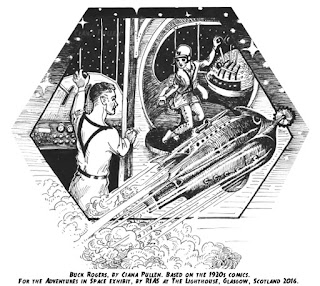
Buck Rogers, illustration by Ciana Pullen
A cobbled-together interpretation of several Buck Rogers comics from the 1920s. The early comics have gorgeous line work, and still have that Victorian influence. On one hand, Wilma is way cooler than in later versions, and on the other the premise was ragingly racist. The pre-Atomic Age spacecraft designs were wild. They were all wood paneled and seemingly inspired by antique scuba gear. The ship in this illustration is an exact copy from one of many in the comic, while the rest is something I made up in the original style.

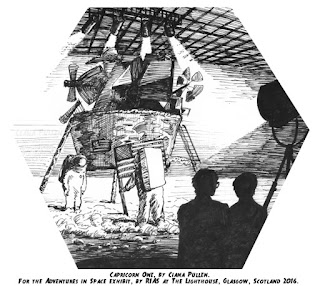
Capricorn One, illustration by Ciana Pullen
I haven't seen Capricorn One, and I probably won't, but the plot as described on Wikipedia is long and winding and involves O.J. Simpson. This scene shows shady government operatives forcing unwilling astronauts to film a fake moon landing in an airplane hangar in the desert. I regret not outfitting one of the mystery men in silhouette with a cigarette, as a nod to The X-Files.

Destination Moon (film), illustration by Ciana Pullen

Fahrenheit 451, illustration by Ciana Pullen
A character from Fahrenheit 451 who chooses to die with her books when the firemen come for her. Fire, as it is captured in daylight on film, just doesn't look right in a black & white line drawing, so I completely made up the flames and smoke, and had a lot of fun with the line work.

The Forbidden Planet, illustration by Ciana Pullen
The space-babe from Forbidden Planet and Robbie the Robot. I gave the "garden" studio set a much-needed visual upgrade. Unfortunately none of the interior architecture was iconic enough to make a recognizable illustration, but the Professor and his daughter live in what is basically a ranch style house in outer space with really awesome interior decor.

Frankenstein, illustration by Ciana Pullen
An interpretation of the original Mary Shelly Frankenstein novel. Glancing back over the original plot (which had been completely replaced in my mind by the über-melodramatic Kenneth Branagh version), I was surprised how much the famous android's monologue at the end of Blade Runner had in common with Frankenstein's creature's confrontation with his creator. 

The Factory Floor from Hitchhiker's Guide to the Galaxy, illustration by Ciana Pullen
Actually drawing this made me appreciate how short Zapp Branigan's tunic (?) really is.

The Factory Floor from Hitchhiker's Guide to the Galaxy, illustration by Ciana Pullen

The Impossible Voyage, illustration by Ciana Pullen

Jurassic Park, illustration by Ciana Pullen

Rossum's Universal Robots, illustration by Ciana Pullen

Sleeper, illustration by Ciana Pullen

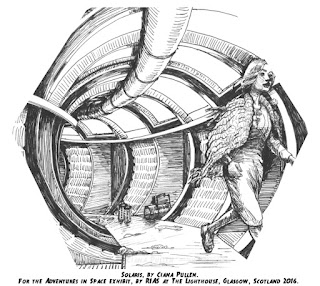
Solaris, 1972 Tarkovsky film, illustration by Ciana Pullen
This exact scene doesn't exist in Solaris (the 1972 version), but I love the way Andrei Tarkovsky had people move through his scenes, so I added the female character gliding off the edge. I have yet to watch Solaris (it's on my list!), but I admired the decision to clothe the requisite Space Hottie in a macrame cardigan and comfortable ponytail. I guess that might have been a Soviet thing.

Future London from Star Trek, 2009, illustration by Ciana Pullen


The Day The Earth Caught Fire illustration by Ciana Pullen

THX 1138 illustration by Ciana Pullen


Tintin - Destination Moon illustration by Ciana Pullen

Tintin - Explorers on the Moon illustration by Ciana Pullen
The original cover illustration showed their backs from above, and the rocket they see before them. I changed this illustration to show their faces but, mostly, to better showcase this amazing dog space suit.

War of the Worlds illustration by Ciana Pullen
I made this composition up, but it was cobbled together and done in the style of the first illustrations for the 1898 novel War of the Worlds. They're absolutely beautiful, strangely terrifying, disarmingly inventive, and well worth the image search.


Tuesday, July 17, 2012

What is art?

I cannot believe I'm asking this-- or writing the answer voluntarily-- as I was sick to death of this question by the first year of art school (and sicker by graduation). But unlike years past I'm not b.s.-ing my way through an answer (not consciously anyway) and I'm finally satisfied that I have an answer that exists outside the untenable binary of genius / loser, art / craft, transcendent / kitsch that is particular to post-Renaissance modernity. [Image: Lisa Simpson holding her sax in front of clouds shaped like Bleeding Gums Murphy, an obvious spoof of Simba's dad-cloud apparition from The Lion King]


***

Art is the notation or commentary that you make on life, similar to the notes you take in class. [Image: Lisa, Marge and Homer Simpson watch a meteor shower]

***

Some things you copy down because you need to know them. Or because it is interesting enough as-is that it's worth remembering. You usually parse what you believe is the most important or salient fact and make a note of only that, particularly when it is representative of a bulkier portion of the learning material. This selectivity reflects a combination of your personal values or intellectual system, and what the teacher (i.e. cultural authority) says is important.... [Image: Lisa and Homer Simpson watch TV in awe]
... I'm alluding to classical Academic art, cave paintings, scientific illustration.... [Image: Homer as da Vinci paints Lisa as the Mona Lisa]
... most portraiture.... [Image: storage room full of statues and paintings of Mr. Burns in many styles]
... and historic monuments. [Image: Homer Simpson imagines himself playing Foosball with Michelangelo's David]
***

Other times you may jot your own abstract theories of the material in the margins of a novel or history book: leading questions to remind you later of your thoughts, or your theories pertaining to the text which usually reflect your larger cultural and intellectual environment, such as parallels with material you're learning in another class.... [Image: Lisa Simpson dressed like Sherlock Holmes, i.e. a detective]
... Here I'm alluding to Abstract Expressionism... [Image: 3-D Homer Simpson paints crazy lines like Pollock]
... art which advances a theory such as Futurism and Cubism... [Image: spoof of Duchamp's Nude Descending a Staircase featuring Homer Simpson stumbling cubistically down a staircase]
 and mystical or religious art. [Image: Lisa Simpson reads Walt Whitman's Leaves of Grass]
***

Or maybe the class doesn't interest you and you're doodling unicorns in your notebook and making escapist fantasies. I'd say these "notes" are still reflective of the class because 1) they were produced because you were in class and 2) they are often subconsciously related to the material or are a reaction to it, such as a cartoon of your teacher with a Hitler mustache. Here I'm thinking of escapist art, fantasy, sci fi, satire, mindless entertainment, psychadelia, decorative art and art for the sake of pure beauty. [Lisa Simpson dances while Chief Wiggam eats a donut in a spoof of David Lynch's Twin Peaks where Agent Cooper dreams of the Black Lodge]
***

In this analogy community happenings or collaborations might be a sort of group study session... [Andy Warhol holds a giant soup can above a cowering Homer Simpson in a Dali dreamscape]
 ... or lab class where you learn through pre-designed experimentation. [Image: Lisa Simpson plays the sax in band with other kids]
***

You mostly make the notes for yourself but you might share them if they are outstanding, or if note-taking resources are scarce, or if someone else needs to use them. [Image: Lisa Simpson stands heroically in front of a sunset]
***

And while many of us were forced to take notes in class because we wanted to pass the tests or because our teachers made us, "notes on life," i.e. art, are usually voluntary.... [Image: Bart Simpson does write-offs reading, "I WILL NOT EXPOSE THE IGNORANCE OF THE FACULTY"]

... Maybe we have never come across an adequate representation of life quite as we've experienced it, and we want to make note of our version of events-- for the pursuit of a Higher Truth, in order to help others going through the same thing, because we think our thoughts could entertain others, because we think our experience is super important, or because we think we have something better to offer than what already exists (plans for the future, proposals, fantasies, utopias).... [Image: Lisa Simpson reading Sylvia Plath's The Bell Jar]
... Maybe we aren't allowed to express certain thoughts or do certain things in real life, so we express them in abstract ways.... [Image: Lisa and Bart Simpson peruse a copy of Public Nudity: Codes and Statutes]

  ... Maybe we're taking notes on behalf of a huge group of people: carving our tribal history onto a vessel, or making something to entertain every child in an orphanage, or documenting a disappearing culture, or inspiring social justice.... [Image: Lisa Simpson points an accusatory finger with the caption, "The whole damn system is wrong!"]
... Or maybe we feel compelled to take notes and we never really understand why. [Image: Lisa Simpson holds her sax and looks up as Bleeding Gums Murphy sits alone on a bridge in front of the moon playing his sax]
***

And just as the division between the material being taught and the notation of it (or between teaching and learning) exists only because we say it does-- because we are conscious of ourselves versus others and the linear flow of time, because modern large industrial and / or capitalist societies value the division of labor (teacher/student), because we are a society of domination that values a hierarchy of information based on class markers-- so the division between art and life exists only because we say it does, and for the same reasons. [Image: Lisa Simpson plays her sax while Homer chills out on her bed and listens with a bag of chips]


Tuesday, November 22, 2011

Kwanchai Moriya

 Kwanchai Moriya, an illustrator based in LA, does all sorts of work from cartoons to collage to architectural fantasy drawings. But here are some of his portraits:


Kwanchai Moriya [Image: blonde thin white woman holding a baby sits in a throne with her legs crossed and arms firmly planted on the armrests, looking steadily at the viewer. Background is thinly layered dark swirling acrylics that look like an outer-space night sky and fantasy city skyline. The whole thing has a science fiction paperpack cover feel to it but the painting is left undone and abstracted in some spots.]

Kwanchai Moriya. [Image: loose oil sketch of an older man wearing pastel blue on black background. Paint is drippy and brushtrokes are large. Features are very basically blocked in.]

Kwanchai Moriya. [Image: painted portrait of a chef seated, in uniform, before a table. She holds a large knife across her knees. A coffee or tea pot and some other utensils are on the table. The bottom half (legs, under table) is left reddish, drippy and thinly painted. The chef's white clothes and skin is thickly and realistically painted. The top background is thickly blocked in white that silhouettes the figure and objects on the table.]

Kwanchai Moriya. [Image: painted head & shoulders portrait of youngish Asian man wearing a white button-down shirt with red tie leaning back on a couch. The light source leaves most of his face in mid-shadow, his expression reading as non-plussed or tired. Brushstrokes are blocky and Cezanne-like.]

Kwanchai Moriya. [Image: thinly layered acrylic painting of the head & shoulders of a youngish woman in front of an abstract concentric circular background. She appears to be wearing headphones or some sort of suit/helmet but it's hard to distinguish because the layers are transparent and slightly abstracted. The woman's appearance is evocative of 1950's and 60's Chinese or Korean propaganda posters, while the background is evocative of outer space, a void or a record.]

Kwanchai Moriya. [Image: pencil sketch of older white woman in profile leaning her chin on her hand. The planes of her face are emphasized and her curly hair is drawn loosely and expressively.]

I don't know if Moriya buys into the notion of "capturing" a person's character in a portrait or if that's his intent, but all of these people are so interesting. The way he's posed them or cropped and arranged the pose if it's from an art class has a very narrative quality that I'm envious of.