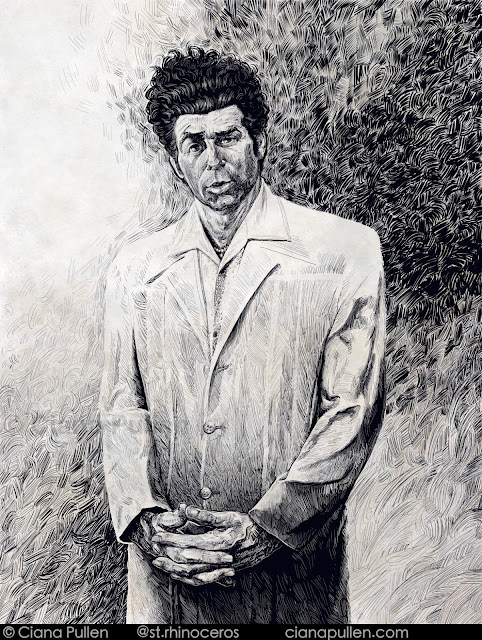
This was a fun drawing and a chance to learn Procreate on my iPad. It's for sale as an NFT on Versum.xyz, which is an eco-friendly NFT art trading site. The idea of trading NFTs seemed a little abstract to me at first, but I like that artists can collect royalties on subsequent resales of their art. That is solid.
Kramer, digital drawing by Ciana Pullen 2022. For sale here.
Admiral Sir David Beatty, Lord Beattyby Cecilia Beaux, c. 1920. (image via) The war-torn horizon immediately conjures images of Napoleon and of J.M.W. Turner's storm-tossed seas.
A distinct style that arose for society portraiture in the Belle Époque and Edwardian era (1880s-1910s), I'm sure you've see it, that certain something that unites the work of Cecilia Beaux, John Singer Sargent, Anders Zorn, Therese Schwartze, Joaquín Sorolla, William Merritt Chase, Lilla Cabot Perry and Giovanni Boldini. It's why all these rival's work looks a bit alike, and why critics engage in a fun circular game of calling each painter's work derivative of the other. But it's hard to know what to call the style. It isn't Impressionism, even though the brushtrokes are loose and fluid, natural light takes center stage, and the implied movement of the compositions looks strikingly modern, like a snapshot. It's very realistic and slightly idealized-- but it's not the Academic style either. Yet it was clearly suited to turn-of-the-century high society, that glittering slurry of new industrialists and old aristocracy: fresh yet unthreatening, classic but not stodgy, audacious yet respectable. Where, then, did it come from?
Velasquez. Yes, the Spanish painter from three centuries prior, the one who painted Las Meninas. His loose brushwork and thick buildup of wet-on-wet brushstrokes ran counter to the prevailing 19th century Academic tradition of perfectionist painters like Ingres. But it was hugely influential to figure painters like Carolus-Duran in Paris and Federico de Madrazo y Kuntz in Madrid, each of whom were prolific and influential instructors of the mid-1800s.
Also arising in the mid-1800s were two schools of plein aire (outdoor) painting: Barbizon in France and the Macchiaioli in Italy, both precursors to Impressionism. While the later Impressionists often used blue-purple for shadows, thus creating a dazzling vibration of color contrasts wherein the entire painting seems bright and fleeting, the Barbizon and especially Macchiaioli shaded the traditional way, with black. You wouldn't believe what a difference this makes, nor how hallowed the tradition, but it anchors a painting firmly on solid ground, as well as in the past. Nevertheless the Barbizon and Macchiaioli painters dared to keep their brushstrokes sketchy and their paintings spontaneous, to let layered patches of color and shadow shimmer on the surface instead of blending everything together. They, too, were inspired by Velasquez, but moreso by English landscape painters and old Dutch and Flemish masters. The later society portrait painters would adopt many dazzling techniques of the Impressionists but they continued to shade with black.
Then there was James Abbott McNeill Whistler. All these portrait artists claimed him as an influence. To them he represented more than an admirable style, but a collection of bold modern ideas (by 1860s standards). Half a century before Kandinsky, Whistler was flirting with abstraction and naming his paintings things like 'Nocturne' and 'Symphony' to draw parallels between pure visual composition and music (his musician friend suggested it, and to Whistler's immense pleasure the titles pissed off the art critics to no end). He had no time for allegory or morals-- he was interested in "art for art's sake," that is pure form, pure color, pure realism rather than idealized Greek goddesses or art with some sort of moral message, which was favored by the predominant Academic tradition. As such Whistler's work incorporated an element of decorative arts (which, after all, claimed no higher moral purpose than to be beautiful). Whistler was mentored by Courbet (as was his friend Carolus-Duran). Courbet was in turn inspired by Velasquez and the Flemish painters like Rembrandt.
This entire lineage is interesting because while Academic Style built upon the predominant traditions of the previous centuries, these society portrait artists built on all the alternative traditions which flourished in the periphery.
This "alternative lineage" idea is completely my own take on it, though.
I don't know if general art historical consensus would agree because it
doesn't have much to say on the subject at all. Because these portrait
painters drew on alternative traditions, they were never on the cutting
edge of anything (neoclassicism, romanticism, pure impressionism,
fauvism, abstract expressionism, etc) and have been almost completely
left out of the narrative of art history. They're considered unimportant
in the progression and eventual triumph of unsentimental abstract
expressionism. Sargent, Zorn and Sorolla are beloved, but most people
don't learn about them from a boilerplate art history class. They simply
stumble across them on Pinterest or in a coffee table book in some
waiting room.
In their heyday, though, these artists were considered forward-thinking. So as Ingres' old-fashioned style dominated the 19th century, his style became associated with it. The new generation of bright (rich) young things wanted something new, something that represented them, yet they still were searching for the next Old Master, to own what their grandchildren would consider important art. Each aspiring young portrait painter who studied in Europe was right at the center of it, various influential movements as they unfolded in real time, meeting their modern idols at cafes and copying the old masters in museums.
And then there was Cecilia Beaux, stuck in Philadelphia.
There was one good place to study art in Philly, and that was at Thomas Eakins's academy. But everyone knew that place was full of freaks. Ever since Eakins had exhibited a graphic painting of a surgery in progress, no respectable woman would touch his school, even if he was a great painter, and even if his school did allow women to study anatomy.
Beaux's concerned family found a relative to teach Beaux instead, one Catherine Drinker. After studying with Drinker and desperate to make some money to support herself and her family, Beaux turned to painting portraits of children on porcelain plates. People would mail in photographs and she'd mail the plates back to clients as far away as California. She drew advertising lithographs ad technical illustration as well. "This was the lowest depth I ever reached in commercial art," she said, "and
although it was a period when youth and romance were in their first
attendance on me, I remember it with gloom and record it with shame." But the money did afford her the independence to continue her studies ("only until marriage of course," she told her family and, to an extent, herself). More importantly it taught her that mothers would do anything for portraits of their children. (I once had this same "ah-ha!" moment with pet portraiture when I saw someone go into the Louis Vuitton store pushing a gigantic dog stroller with a shivering chihuahua inside).
Beaux had to admit growing admiration for Eakins' Academic-style work. And she knew she had to step up her game if she didn't want to be painting plates forever. In the end she worked up the nerve to attend the academy but studied with other teachers. "A curious instinct of self-preservation kept me outside the
magic circle." Sadly Eakins would be fired from the academy for his practice of allowing women artists to study anatomy. Philadelphia was not ready for his ideas.
Somewhere along these studies she picked up a lifelong belief in phrenology, which was a preeminent form of quackery from an embarrassing period in history when scientists believed that behavior and character traits correlated with various physical features. At its worst this idea was applied to blatantly racist, sexist, classist and xenophobic agendas-- that's why it's earned such a nasty reputation nowadays. However I find it interesting that a portrait artist would pick up phrenology and run with it. It makes me reconsider the practice of cartooning where physical features are exaggerated to show personality. Much of portraiture is after all just glorified cartooning, where the artist manipulates the sitter's physical appearance to turn them into an expressive character.
Les Derniers Jours d'Enfance by Cecilia Beaux, 1883. (image via)
With the exhibition of her first serious work, Les Derniers Jours d'Enfance, Beaux allied herself with artists like Whistler and Mary Cassatt. Beaux's reputation grew and she opened her own portrait studio. In just a few years she was able to charge as much for a commission as Eakins himself. She was good, but she wanted to be great. She craved a European education and in 1888 at age 32 she set sail for Paris. "Remember," begged her loving Aunt Eliza, who was anxious for her unmarried Quaker niece amid the notorious vices of the Paris art world, "you are first of all a Christian – then a woman and last of all an Artist."
Paris hit Cecilia Beaux like a ton of bricks but she thrived in the adversity. It wasn't Bouguereau, the most nurturing of her instructors, who buoyed her spirits the most, but the underhanded encouragement of the severe Fleury, eyeing her efforts: "...We will do all we can to help you."
At the same time that Beaux was training in the Academic style she was also drawn to its polar opposite, Impressionism. She experimented with incorporating it into her style but found she was too precise and concrete a painter to really adopt the style. However she did lighten her color palette significantly, beginning a lifelong love affair with white-on-white effects. She also studied the effects of natural light and outdoor painting which she would put to use later in her career with outdoor portraits and landscapes.
Twilight Confidences by Cecilia Beaux, 1888. (image via) Beaux
painted this early work after spending the summer at an artist's colony
in Brittany. She completed numerous studies for this, and the painting
is her first foray into plein aire (i.e. outdoor) painting. The play of
fleeting natural light is obviously her main focus and the white Briton
bonnets of the women serve as perfect vehicles.
New England Woman, by Cecilia Beaux, 1895. (image via) While this painting was completed a decade after her time in Paris you can clearly see the influence of Impressionists like Morisot and Cassatt. Beaux also was an admirer of Whistler, and one of his most famous portraits was a girl in a white dress in front of a white curtain, titled Symphony in White.
When Beaux returned to Philadelphia she dedicated herself completely to painting. She chose never to marry or even to have serious relationships so she could focus. Her extended family welcomed her back home, and all of the time she lived there and worked in her studio, "I was never once asked to do an errand in town, some bit of shopping…so well did they understand." (everyone who works from home lately will understand what a gift that is). She maintained a strict daily routine with a punctual starting and quitting time.
The year after her return William Merritt Chase (the prominent Impressionist and society portrait painter) claimed, “[Beaux is] not only the greatest living woman
painter, but the best painter who ever lived!” I personally disagree-- no one beats Anders Zorn, come on-- but Beaux was clearly earning a solid reputation stateside. She had multiple pieces exhibited together with John Singer Sargent who was much more well-known at the time, and a critic was famously overheard making very sideways compliment: "I see Sargent has signed his best paintings, 'Cecilia Beaux.'" He meant that her style was very derivative of his, but also that her work was superior. Her work is still frequently compared with his-- and they are very similar-- but as I pointed out at the beginning of the post, both Beaux and Sargent were basically painting in the style of Carolus-Duran.
In a reversal of the previous decade when she had difficulty acquiring training, Beaux was hired as the first woman to teach at the Pennsylvania Academy of Fine Arts. Philadelphians were proud and she became a very popular instructor for the next twenty years.
Beaux went on to exhibit large murals at the Chicago World's Fair, to amass a long list of sought-after clientele including Teddy and Edith Roosevelt, and to have her paintings exhibited in Paris to acclaim.
By the early 1900s several of Beaux's extended family members died. Beaux was devastated, as she had been orphaned at birth and raised, with her sister, by her grandparents, aunts and uncles. She found it too painful to stay in Philadelphia and relocated to a country home in a wealthy community. She began summering in New York as well. Interestingly, she incorporated hiking and leisure into her daily studio schedule because she considered the steady maintenance of energy to be crucial to her artistic output. One must accept, she believed, that art will work one to exhaustion, so an artist must plan one's day in a way that re-energizes oneself.
Abruptly in 1907, American artists overhauled the Impressionist era, moving on to gritty social realism, Dada and then abstraction. But Beaux never considered moving on from her style.
"These men [Rubens, Memling, Mabuse, all Renaissance and Baroque painters] were not reformers," she wrote. "Theirs was the earnest desire toward
perfection. Not to break down, but to build." For Beaux the old masters had set art as an ever-fixed mark that does not alter when it when it alteration finds.
Despite the art world moving on the last decades of her life were filled with prestigious honors and awards of every sort. Toward the end of her life she broke her hip and her painting slowed considerably. She died in 1942 at age 87.
Sita and Sarita, by Cecilia Beaux, 1893-4. (image via) Who wouldn't like to have their portrait made like this, looking mysterious with a witchy cat. Beaux sometimes added a touch of something slightly odd such as an unusual pose or composition which made the image more attention-grabbing while allowing the sitter to retain their dignity.
Mrs. Alexander Sedgwick and Daughter Christina, by Cecilia Beaux, 1902. (image via) The pose in this is interesting. The mother's back is turned, and she isn't even more than a sketch at the edges. Yet she's very prominent in the painting.
Sarah Elizabeth Doyle by Cecilia Beaux, c. 1902. (image via) Sarah Doyle was a suffragist and educator who founded the Pembroke College in Brown University. Her former students commissioned this portrait from Beaux, to “be of itself a
work of art of the highest merit" which would acknowledge Doyle's “deep and lasting influence upon the
women of this community,” and “perpetuate her strong, womanly personality.” Doyle is shown here in her academic robes over her personal clothes, with a pose and expression that radiates intelligence and gravitas (to get in trouble and be sent to her principal's office would be terribly intimidating). The simplicity of the forms and fluidity of the brushstrokes create a confident sense of balance. The red background appears plummy purple in some photographs of the piece, and if that's the case in real life it would be an allusion to the symbolic colors of the women's suffrage movement: white, green and purple.
Man with the Cat (Henry Sturgis Drinker)by Cecilia Beaux, 1898. (image via) Drinker was a wealthy and stylish railroad executive who married Cecilia Beaux's sister. He was also brother to Beaux's first art instructor, Catherine Drinker. Known to be a strong personality, the painting seems to be some sort of recognition and accord between his strong personality and Beaux's own formidable character (according to unsigned commentary at Smithsonian's image database). This man was the pinnacle of glitteringly wealthy East coast society, and here he is so comfortable with himself that he slumps in a chair to accommodate the cat on his lap, the literal lap of luxury. Besides the pose I love the technique of this painting. The brushstrokes are clear watery pools of color, the side lighting that splashes over the folds of his suit beautifully divides his face in two.
After the Meeting by Cecilia Beaux, 1914. (image via) I adore this composition-- the high contrast pattern play, near-abstract blocks of color, and how it leads the eye in an unusual upward zigzag. The bold layering of patterns echoes whatever peppery thing the woman in the chair is saying, and the lively composition which zings back and forth hints at a gathering of others who are listening and ready with a lively answer. According to writers in 1915 the "meeting" certainly refers to a women's suffrage meeting (note the green and white dress) and the "restless energy" is meant to characterize those who attended, someone who talks with her hands and grabs attention. The flattened, color-blocked composition was a pointed reference to abstract European modernism and drew a parallel between the modernism of the woman and of the painting itself (and possibly painter). Meanwhile the careless simplicity of the brushstrokes and lack of shading especially in the face was a reference to fauvism, another modern art movement. Beaux considered herself a "New Woman," an independent cultured citizen who supported women's rights.
Portrait of Alice Davison by Cecilia Beaux, 1909. (image via) I think the way she painted Central Park is neat.
Cardinal Mercier by Cecilia Beaux, 1919. (image via) While this man doesn't look like someone I'd want to know the painting itself is beautiful. The tonal value of the red against the background is somehow surprising; where you'd expect dramatic contrast (as in a Baroque painting) they're separated only by outline. The mottled misty quality of the figure creates a separation from the viewer, as if he's not real. The overall effect really sucks you in.
So, here is my portrait of Cecilia Beaux for Day 3 of Inktober. I readily found two of Beaux's self portraits online, and while I quite like them as paintings I didn't think they made very good reference images. Nor were the photographs of her very descriptive. With some digging I found a watercolor portrait of Beaux by another artist named Rosina Emmet Sherwood. (Sherwood's life and work is worth taking a look; she did some gorgeous children's book illustration.) I tried to mimic Beaux's own long fluid brushstrokes in her blouse and in the "scumbled" background. I also noticed that she frequently employed a subtle but thick outline to separate the figure from the background. It creates a slightly art-nouveau-style effect, like a rich glaze puddling around the contours of a vase. You can see it in the portrait of Sarah Doyle above with the red background. I added the bow on the blouse to anchor the composition and cropped the image way in from Sherwood's original seated pose; I like how it makes her look like a thoroughly modern "Gibson Girl."
This
post is part of a series of posts from Inktober 2020 about women
artists of the 17-early 1900s who each had some significant connection
to Paris, France. Each post focuses on the art-historical context of the
artist among her colleagues and ends with a portrait I did in ink of
the artist in their style (roughly). Other posts in the series:
I went for another grocery store still life for the final day of Inktober. It's all seasonal fall/winter fruit (except the honeydew, who even knows when that's ripe) and somewhat low-carb friendly (except the persimmon, I suspect). You're supposed to eat just a little, though, on a low-carb intermittent fasting diet, not to break your daily fast with a giant fruit salad, which is what I did before I even finished this drawing. No regrets, it was delicious. Anyway, this is what I gave up last year while dieting (an overall positive experience), and I've since added back in a little fruit and the occasional healthy carbs. Diet talk is never especially interesting so I'll just leave it at that, but suffice it to say this still life is VERY personally relevant to me. These foods have occupied quite a lot of brain-space lately. They should pay rent.
I was happy with how this turned out. The honeydew looked especially nice, and the little silver cake fork (a flea market find) stood out against it just like it did in real life. I was happy with the zig-zaggy interior and rough exterior of the pear as well. As it turns out, pomegranate seeds are incredibly fast and easy to draw. The persimmon skin had just the right value and shine. The fruit pressed against the side of the wine glass was a fun challenge in black and white.
Inktober 2019, Day 31, Ripe, by Ciana Pullen / St. Rhinocéros
After devouring the fruit salad I carved a Jack O' Lantern, since it was
Halloween. And I got a Trick-or-treater! She was some sort of zombie
princess I think. I ate the rest of the mini-Snickers myself.
Just a standard pentagram with some antlers for this pumpkin. Nothing too fancy.
After so much drawing from photo references and from my imagination, I wanted to get back to some proper drawing from life. So I picked up this fish from the grocery store, and to add some interesting distortion and a bit of a challenge, I put it in a glass of water. But the fish was so long I had to add a second glass. I rather liked the odd composition, and the fish looks like it's trying to stay alive under the most constrictive possible circumstances (it was fully dead). I cooked it up for dinner afterward. My cat was extremely interested in the entire process.
Inktober 2019, Day 30, prompt word "Catch." Dip pen and marker, 8 x 11 in. by Ciana Pullen. [Image description: realistic black and white pen drawing of a foot-long mackerel or trout type fish. The head is resting in a cut-glass tumbler full of water. The tail is resting in a glass mini beer stein behind the tumbler. The fish's body arches between the two glasses. The distortions of the water and facets of the glasses break up the fish into several different planes. Each glass casts a shadow with scattered light across the page to the right.]
When I was 5 (or 6 or 7...?) I had a super bossy friend who was always the best character in whatever we played, like
April O’Neal or Belle and then I’d have to be Shredder or the animated
clock. She had a bunch of plastic horses, like ya do, but there was one
Ultimate Pony that was pearlescent lavender with mega-hair and she
always got to be that one. One day I chose it first, so she challenged
me, and I grabbed it and took off running. Unfortunately I tripped on
the edge of the carpet and fell face-first on the hardwood floor. My
nose basically exploded in blood and I had to go to the hospital (never
having played as the Ultimate Pony). My nose is a bit crooked now and
I’m not sure how much is genetic and how much is battle scar.
The top bit is imaginary, but the nose close-ups I sketched from a mirror. Except the full profile, for which I used a camera phone. That's a pretty accurate depiction of the Ultimate pony, as I still remember her clearly, decades later.
Inktober 2019, Day 29, prompt word, "Injured." Ink pen and marker, 8 x 11 in. by Ciana Pullen. [Image Description: black and white drawing of a little girl falling on her face, in mid-air just about to hit the ground. A tasseled rug is just under and behind her, and a toy pony flies out of her hand. In the bottom third, several overlapping realistic sketches of a nose and eyes from various angles take up the rest of the space.]
Inktober 2019, Day 28, prompt word, "Ride." Ink pen and marker, 8 x 11 in. by Ciana Pullen. [Image description: black and white realistic drawing of a woman in a knit cap and scarf sitting by a dark train window. Her darker reflection is in the window. At the bottom of the page a side-view of a subway train in the dark shows three lit windows illuminating sketchily drawn passengers. The same woman pictured above with the same white cap is visible through the window. It reads a bit like comic panels showing inside and outside the train.]
I spend a lot of time bingeing on nonsense online. For "coat" I wanted to convey that cocoon of stupor that you get with total media escapism.
Inktober 2019, Day 27, prompt word, "Coat." Dip pen and ink, 8 x 11 in. by Ciana Pullen. [Image description: black and white realistic pen drawing of a woman's face surrounded by floating downy feathers. She looks up and to the left, out of frame, and the close-up is cropped at her forehead, cheeks. and neck. Her expression is wide-eyed, slack-jawed, dazed and entranced. A light like a screen is reflecting off her eyes.]
I've seen a lot of illustrators create atmosphere-monsters, and I've been wanting to give it a try myself. They create a lot of atmosphere at the horizon (clouds, smoke, the haziness of distance) and slightly delineate the monster's form (usually tall and lanky, a giant robot or massive skeletal creature), but leave the eyes blank and white (or in color, if it's a color illustration) so they glow. Having the atmosphere at the horizon makes the monster look super-tall, towering above skyscrapers. Here's an example by Canadian and French illustrator Nicolas Delort:
NOT my drawing. This is by Nicolas Delort, a Canadian and French illustrator. It shows the type of bright-eyed atmosphere-monster I'm talking about.
The funny thing is, the original illustrations from War of the Worlds used the same conceit for the killer robot Martians over a century ago. Maybe Henrique Alvim Corrêa even invented it for the novel. I ran across his illustrations a few years back while illustrating for an exhibit in Scotland about the history of sci-fi and architecture. Here's Corrêa's take in 1906:
NOT my drawing. This is a 1906 illustration by Henrique Alvim Corrêa for War of the Worlds.
So I went to create my own atmosphere-monster to express how, walking down a city street in dank weather, you feel both omnipresent connection with the city at large, and simlutaneously part of a tiny huddled microcosm under your umbrella or in a cloud of light from a shop window. I started, naturally, with the atmosphere. I chose a rainy city street at twilight, a time which seems somehow even darker than night when it rains. However I got so into the foreground and rainy street scene that I wish I'd cut the monster out altogether so the focus was on the foreground. Oh, well. This might be a drawing I retool in the future.
Inktober 2019, Day 26, prompt word, "Dark." Dip pen and ink, 8 x 11 in. by Ciana Pullen. [Image description: cityscape showing a line of pedestrians with umbrellas crossing the street over a few clouds of billowing steam emerging from manholes. Behind them is a row of cars silhouetting them against headlights. On either side are tall buildings. The sky is dark and it's raining. The people's silhouettes and the headlights create black and white striped reflections on the wet pavement. On the right side, a corner shop window is illuminated. In the background, between two distant buildings and against the sky, the outline of a humanoid monster peers at the people and reaches out. Its eyes are blank white hearts.]
Once again I broke my "must be personally relevant" rule. I was inching toward the end of Inktober and worn pretty thin, so when faced with brainstorming I just went for a good old portrait. Easy enough because it's my specialty, and usually a crowd-pleaser. Lots of other people chose this same subject as well, a character from Orange Is The New Black named Taystee. While not personally relevant, OItNB is a really good show, the character is extremely interesting, and the actress does a great job. It is unreal how pretty she is without makeup, but that didn't come across in this portrait. I went for an expressive film still rather than a pretty one.
The hair texture was fun. I relied on a few old favorite techniques that I developed when I drew portraits live in the park in the US. Occasionally someone with massive hair will show up and unless you want them to be sitting for hours, you need a few visual shortcuts. But it was my first time using ink pen instead of shaded charcoal, so it was a bit different.
I wasn't that satisfied with the result though. It was overall too dark (but it's ink, so what are you gonna do) and the crosshatching on Taystee's face was too rough. But it felt so good to have the rest of the day free without a drawing looming over me.
Portrait of Taystee (actress Danielle Brooks) from Orange Is The New Black. Inktober 2019, Day 25, prompt word, "Tasty." Ink pen and marker, 8 x 11 in. by Ciana Pullen. [Image description: black and white realistic drawing of the head and shoulders of a woman with a large afro. She wears a cotton prison shirt that looks like scrubs. She leans forward, squinting out of frame to the left, with a frustrated and exasperated expression. The mark-making on the shirt is a little chunkier and more abstract.]
Inktober 2019, Day 24, prompt word, "Dizzy." Dip pen and ink, 8 x 11 in. by Ciana Pullen [Image description: The picture plane is broken into several overlapping strips containing different images, like a collage. It's a black and white pen drawing. In the main center image a man and woman hold hands as the man leads her down a narrow outdoor stairway in an old city, much like a back alley. Under their hands and arms is another image strip of beer and wine bottles, and over them bisecting the drawing diagonally is a thin strip showing a winding tree-lined two-lane highway viewed from above with a car on it. On the right another image shows a fancy old apartment building with a domed roof and electrical wires with birds on them, and on the left is another image of shadows from blinds in a dark room. In a thin strip near the top is a hand and iPhone on a black background.]
This is about spending nice time alone. I was mostly alone over this past Christmas, and did a lot of traditional stuff by myself. I wouldn't want to do that every year, but it was actually really nice. I don't have an actual fireplace, but I think that gets the "ancient" feeling across.
Inktober 2019, Day 23, prompt word, "Ancient." Dip pen and ink, 8 x 11 in. by Ciana Pullen. [Image description: Black and white drawing of five duplicate versions of the same woman in a striped shirt and jeans hang out around a fireplace. The perspective is from inside the fireplace, and the top of the image is smoke and sparks around the mantle. The women hanging out look calm and relaxed, drinking tea, reading books, and leaning on each other. They're all lit by the fire in an otherwise dark space.]
I struggle with "less is more," especially with ink, so I was especially pleased with the light markmaking in the background of this.The marks on the shirt also look sculpted, which was a cool effect. This was, once again, the effect of poring over some old Anders Zorn drawings. I used a reference photo for the back of my own head, because believe it or not I don't see it that often.
Inktober 2019, Day 22, prompt word, "Ghost." Dip pen and ink, 8 x 11 in. by Ciana Pullen. [Image description: black and white realistic drawing of a woman walking down a banal institutional hallway, perhaps of a school or hospital. The woman is viewed from the shoulders up to mid-skull, and from behind and to the side. Her other shoulder is out of frame. On the visible shoulder sits a tiny duplicate version of her, wearing the same striped shirt and hairdo, facing backward (toward the viewer and facing out of frame). She rests her face on her hand and looks bored. In the hallway background there is a doorway, an empty metal chair, and some fluorescent lights in a drop ceiling.]
I spent all day trying to think of what to draw for this and I just couldn't. I treasure a lot of things and people, but home and privacy, a place of my own in which to be a raging introvert, popped into my mind first and foremost.
Keenly aware that I was almost out of time for my Inktober drawing, I stole an idea from cartoonist Sempé of two lit windows across a city at night (although his was clearly meant to convey love and was highly two-dimensional and cartoonish in style). Then I used an old photo of Paris for reference and changed it very little in my drawing, except to scoot some buildings around and of course to add the lit windows. That's pretty rare for me, as I don't usually copy directly from photographs, especially photos I didn't take myself, and super-especially photos that are meant to be stand-alone pieces of art, as this old photo could possibly have been (as opposed to workhorse snapshots for some non-artistic purpose). Drawing from life is best, then next-best is from reference photos I've made for the purpose, then from video or gif that moves, or from a collection of photos that I can manipulate and combine to create something new, and then from crappy photos that are much improved by being turned into drawings. Anything else honestly feels like cheating. Stealing ideas, though, I'm okay with, as long as I have something of my own to add. Though I do prefer coming up with my own ideas entirely.
However, the Instagram public has spoken, and my least proud drawing turned out to be everyone else's favorite. Isn't it always that way? People are never impressed by what they ought to be.
Inktober 2019, Day 21, prompt word, "Treasure." India ink pen and ink wash, 8 x 11 in. by Ciana Pullen. [Image description: black and white ink wash drawing of a street corner in Paris, seen from above and to the side. Several fancy old apartment buildings with turrets, bay windows and wrought iron crowd the image, all lit from a street lamp below, and mostly in darkness. The horizon is dimly visible across the city's rooftops and chimneys. A window in a rooftop apartment is brightly lit up in the foreground, and in another building around the corner, a window in a middle floor with a balcony is also lit. The piece is overall very dark and moody and the lit windows jump out at the viewer.]
This one seemed to have universal appeal on Instagram. Apparently everyone's cat does this.
Inktober 2019, Day 20, prompt word, "Tread." Dip pen and ink, 8 x 11 in. by Ciana Pullen. [Image description: realistic black and white drawing of a cat standing on a woman's face as she lies in bed. The woman's face is all scrunched up where the paws are pushing her skin, and she is mostly expressionless with her eyes open and looking at the cat's face. The cat is black and its back and head are cut off beyond the edge of the page, except its nose and muzzle, which are pointed at the woman's face. The nose and whiskers are silhouetted against her black hair.]
Inktober 2019, Day 19, prompt word, "Sling." Dip pen, ink wash, wax crayon, and gel pen, 8 x 11 in. by Ciana Pullen. [Image description: a view straight down a grocery store aisle at waist-level. Fluorescent lights shine overhead at regular intervals. Instead of a ceiling, there is a black galaxy full of stars with a cloudy milky way running down the center. The shopping cart flies off into the galaxy behind the fluorescent lights in one direction and a woman in jeans and a tee flies off in another, upside down in a limp position.]
Inktober 2019, Day 18, prompt word "Misfit." Dip pen and ink, 8 x 11 in. by Ciana Pullen. [Image description: black and white drawing, slightly cartoonish but mostly realistic, of a homeless man. The perspective is from slightly above and almost fish-eye. He's sitting on the ground on some cardboard boxes, while a meaner, more aggressive duplicate of himself stands over him, grabbing his lapels and yelling. The duplicate is slightly see-through, with the tiles of the wall behind him showing through. Foreshortened well-dressed legs walk past in bottom quadrant of the drawing.]
A "Belvedere" is any structure that is designed to provide a nice view, from a gazebo to a castle. In warmer Italian climates they were usually open for ventilation, but as the trend moved North, they were purely ornamental. This is the Belvedere at a local Rococo palace. It looks across a wild field to a pond, across which lies the main castle. A flock of sheep still graze in the field.
Inktober 2019, day 17, prompt word, "Ornament." Ink pen, 8 x 11 in. by Ciana Pullen [Image description: simple, realistic black and white line drawing of an ornate three-story Rococo building surrounded by grass and trees. It has a large domed roof.]
Another imaginary pseudo-Classical creature. I don't know where all this Classical influence came from this Inktober, since I'm not an especially big fan of ancient Greece or Rome. I think it might have been the day at the art museum in Barcelona that did it.
Inktober 2019, Day 16, prompt word "Wild." Dip pen and ink wash, 8 x 11 in., by Ciana Pullen. [Image Description: realistic black and white pen drawing of the head of a roaring lion. Instead of a mane it has hair-like snakes, like Medusa. The snakes are coiled in a way that echoes the movement of the lion's head as he roars.]
The idea for this drawing popped into my head fully formed, apparently straight from my subconscious with no provocation. I'd like to see these creatures in motion. They seemed like they should be vaguely Viking or Celtic, so I did a little research on how those folks looked. Then I looked up weight lifters so I could get an idea of fat(ish) but strong bodies. The Vikings from TV and movies all had Hollywood type bodies, but I just couldn't imagine someone with Megan Fox's physique popping out of the top of a walrus. This is actually an issue I have with The Little Mermaid as well. Every other sea mammal has a nice thick blubber layer, and so should she.
Inktober 2019, Day 15, prompt word "Legend." Dip pen and ink, 8 x 11 in. by Ciana Pullen. [Image Description: A crowd of walrus centaurs (human on top, walrus on bottom) holding lit torches crowds a beach. The atmosphere is darkish and misty. They appear to be rallying. A male is in the foreground with a beard and man-bun and a few markings painted on his chest, face and shoulder. A female is just behind him with a shaved head except for a braided mohawk. The figures behind them are blurrier. Two centaurs holding torches recline on a rocky outcropping in the background.]
I recently visited Barcelona and spent the day at the Museo National de Catalunya; I think the armless classical statues stuck in my mind and produced this drawing.
Inktober 2019, Day 14, prompt word "Overgrown." Dip pen and ink, 8 x 11 in. by Ciana Pullen. [Image Description: black and white pen drawing of a Classical Greek style bust of a woman. Her arms are cut off at the shoulders, as many sculptures are, and a cluster of around six extra hands is growing out of each of her shoulders. She has a simple crown or headpiece, like Diana. The background is blank.]



_-_Google_Art_Project.jpg)


