-->

Monday, January 17, 2011

Tamara de Lempicka

Auto-Portrait. I'm pretty sure this is a photo of the original, but this is a really popular painting to copy. I can see why; she's clearly a bad-ass.


Tunic.


Mrs. Bush. 1929. I think the knees in this are incredible. I also thought the skyscrapers in the background were kind of funny; she's like Ms. Modern Phallus.


Portrait of a Man. Notice the Michael Jackson glove.


Madame Boucard. She looks a little jowl-y, and de Lempicka has clearly idealized her a bit, to great effect. I can't help but wish I could see de Lempicka's take on this aging face without idealizing it, though; there would be fantastic planes and shapes for her to work with. I've seen a few portraits of older people, but they are in a less geometric style.


Kizette on the Balcony, 1927. Oil on canvas.


Femme dans Dentelle ("Lady in Lace).


Duchess of La Salle, 1925. This must have sent the oldsters with their Victorian morals screaming for the hills. I admire how she changed the placement of the buildings, which are usually rising like triumphant phallic symbols behind the subject. In this case they are at the Duchess's feet and a Baroque-style drapery surrounds the top of the figure. The Duchess appears in command of the past, and present, and her sexuality.


St. Moritz. It reminds me of Ingmar Bergman. Her understanding and exaggeration of eye sockets is amazing.


Grand Duke Gabriel.


Compte Vettor Marcello, 1933. (proto-"blue steel")


Irene et Sa Seur. 1925.


Telephone II. I think this is incredible. She looks so ridiculously girlish, like a grown-up Shirley Temple, and I think she might be wearing a sailor-suit of some sort to top it off. But she must be the most sinister, sexual Shirley Temple ever. The telephone, though, is what I can't get over. It reminds me of depictions of teenage girls from the fifties to the eighties or so sitting on their beds yakking into an oversized receiver and being OMG GIRLS. But the phone in this is menacing and black like a gun or masculine machine of some sort. It's more like a scene from a spy movie.

***

Tamara de Lempicka was born to an upper-class Polish family. She saw a man while out at the opera when she was just 15 and staked a claim to him as her future husband; three years later, they married. (I shudder to think who I might have ended up with if I chose my husband at 15.) They moved to Russia but then got stuck in the Russian Revolution and, being well-to-do, her husband was imprisoned. She apparently bribed and flirted his way out of jail, then they went to Paris.

Bohemian Paris in the 1920s sounds AWESOME. She slept with everyone: famous men, famous ladies, artists, actors, royalty. Her husband got fed up and left, but she rebounded with several very avant-garde lesbians. She painted the portrait of a Baron's mistress, then replaced her as the Baron's mistress, and eventually when the Baroness died de Lempicka and the Baron married and went to New York. There she met famous artists like De Kooning, Stieglitz, and Georgia O'Keefe, and probably had awesome sex with them all, and was a wildly successful portrait artist, till the late 1930s when her style changed and she abandoned commercial portraiture.

Her studio and professional conduct were apparently notable as well. People ask me about my studio, and I have to explain that it's more like a work-space, a stall in a warehouse and not a show-room of any sort. De Lempicka, on the other hand, was a glamorous celebrity who kept a large studio in the city that was part stylish lounge, part work-space. She painted in gorgeous clothes with a smock over them and most of her subjects were socialites and royalty.

I really admire her attitude as a portrait artist. Her subjects are in charge of the canvas, completely inhabiting every inch of space, even when they assume a traditional romanticized female "fainting limp-necked waif" posture. Someday I hope to keep a studio like that and command the type of presence she commanded in it. I'm also happy to see her work is getting more and more exposure. I think she's on her way to being an Andy Wyeth or M. C. Escher type of figure: enjoying wide popularity outside of the art world, and respect from within it. She wasn't very innovative, after all; this has watered-down elements of Fernand Leger's cubist style ("tube-ism;" I always hated his work) as well as watered-down elements of the hardcore cubists. She takes some color and atmosphere from deChirico, as well as his references to Classical Greek imagery, but doesn't push the envelope of subject-matter like the Surrealists. And then she borrows from the German New Objectivists, but her work isn't a deeply unsettling comment on post-war society. I think the attitude toward society generated by her paintings is most like an energetic, optimistic WPA mural. But every artist borrows; what she ends up with seems to work.


Edited to add: Wow, this appears to be a continuously popular post! so, all of you de Lempicka fans will probably enjoy this as much as I did.

Wednesday, January 12, 2011

Exit Through the Gift Shop: Banksy

Mister Brainwash, limited edition print for a London show.
Mister Brainwash (aka Thierry), Marilyn-Spock.


[Alert: every spoiler possible plus a bad attitude] I guess the movie is old news to everyone else, but I just saw Exit Through the Gift Shop last night. Banksy directed this documentary about a French man living in LA who decided to make a documentary about world-famous street artists like Banksy, Space Invader, Shepard Fairey and (I reluctantly mention) Borf. But the French-LA man, Thierry, was not a film-maker, and when he showed his weird-ass experimental film to Banksy, who had trusted this man with his secret identity, etc., Banksy felt that his trust had been broken. So Banksy made a film about Thierry instead.

We see Thierry the humble roadie following the famous street artists, filming and helping and putting his ass on the line. We see his wife (!) and kids (!) at home worrying about how to make ends meet while Dad roams the streets of Paris with a bunch of punks. We see him explain how he got into filming with a sad and genuinely touching story about how his mom died when he was a kid and now he wants to capture everything because he worries it will escape him as did his mother. The street artists are interviewed, Thierry the lovable imp entertains us, and then Banksy reveals: Thierry had ripped them off, fooled them into thinking he was a filmmaker. I thought, "Oh Thierry, you stupid jackoff. Look at your stupid film." And then we see Thierry go and mount his own uppity art show. Suddenly he thinks he's an artist. He takes out a second mortgage on his house to hire local starving artists to make pieces based on his instructions. They make a LOT of artwork. He gets a show, and markets it. REALLY well. The guy is, as it turns out, a good showman, and a risky but confident businessman. "Oh Thierry," I thought, "You uppity Frenchman. You're practically stealing the work of REAL artists like Banksy and Shepard Fairey and SELLING it at a massive profit! That's capitalism for ya--whoa, you just made over a million at your first show! Bastard. It's like the emperor's new clothes. Everyone around you knows it."

But at that moment I remembered, "Hey, Banksy directed this thing. Could it be a little... biased?" I considered the interviewees: wouldn't Banksy's friends share his opinion? Wouldn't low-paid artists resent their rookie boss? Wouldn't Thierry's fans sound like morons, since most random people off the streets of LA sound like morons? Hmm. And look how Banksy focuses on how Thierry (gasp!) didn't make the work with his own hands. And look how he shows Thierry thinking about (gasp!) making a living. Look how he's pretending to be an artist.

Wait a minute, though: didn't Thierry just spend years as a sort of apprentice to the best of the best? Hasn't he been making videos his entire life? And wasn't his work they just showed really witty and entertaining?

When the film opens Banksy explains that Thierry wanted to make a film about him but Thierry was just more interesting than Banksy, so the film was about Thierry instead. But now I'm thinking it was a little more malicious than that, more like, "Hey let's turn the camera back around on that traitor Thierry and see how he likes it!"

By the end of the film I had formed some opinions on both men. Thierry seems maddeningly irresponsible, charming, egotistical and full of joi de vivre. He seems like a real artist who thinks had about what he creates, like the director of a play. I enjoyed how he mixed graffiti with a very Warhol-looking pop-art language. He, perhaps unwittingly, mixed two bitingly ironic forms of art into a vernacular that is very appropriate and sincere for a man his age, his socioeconomic status, his town of LA. Wouldn't it deserve a big old eye-roll if a relatively well-off middle-aged white dad decided to go undercover and become a anarchy-touting graffiti artist?

And Banksy. That man is way too rich, famous and adored by the entire fucking world to play the underdog. The irony of a graffiti artist who uses other people's property without asking and makes it his own, having his precious trust broken by an fan who isn't as experienced as he let on is a little much. And he's counting on an audience of seventeen-year-olds and seventeen-year-olds-at-heart who won't think too deeply about this. People who are just waiting to be told by someone they trust, "this is great art. This other stuff isn't." People who think they're rebellious but hold surprisingly conservative opinions: Artists should be too idealistically pure to make money. Art is only real art if the artist made it by hand. Ideas in art are fine, but only if contained in impressive displays of craftsmanship. Real artists are self-sacrificing geniuses of truth who look like a dictionary definition of a rebel. They're just waiting to be told that what they already believe is right. And they desperately want to be in on Banksy's joke.

At the end, both men seemed extremely common: adult children in the Neverland of an Art World already oversaturated with man-children.

11 Portraits of Paris Hilton. Just because.

Karen Kilimnik, Marie Antoinette Out for a Walk at her Petite Hermitage, France 1750.


Jane E. Porter, Paris Hilton Painting: What's a Soup Kitchen?


Justin Lear


Jonathan Yeo


Self Portrait from jail, according to BoingBoing. (I love that she used a straight-edge for the lines in this piece!)


Ralph Ueltzhoeffer

Too bad I couldn't re-post some of the other portraits.

Oh, and I found this review of Karen Kilimnik's awesome installation:
"Karen Kilimnik's artistic persona is that of a daydreaming, scatterbrain American teenager eating unlimited amounts of candy among the splendours of, say, the Wallace collection. Installed for this exhibition within a series of specially constructed 18th-century (ish) rooms, her paintings - such as a portrait of Paris Hilton as Marie Antoinette - hang in what looks like Walt Disney's idea of a stately home. Fashionable art writers approve of Kilimnik's excesses of superficiality and surface. Like teachers showing favouritism towards an extremely pretty - but dumb - pupil, critics have given her top marks. But go and see for yourself. Neal Brown"
Infantilizing? check. Misogynist? check. Pompous? check. Oh wait, my bad-- male artists are totally described as dim-witted, childlike, superficial sex-bombs scheeming for attention while breaking their diet. All the time. Sometimes I hate the internet.

Ishbel Myerscough


Ishbel Myerscough, Sir Willard Wentworth White.


Ishbel Myerscough, Sleeping Man.


Ishbel Myerscough, Self Portrait.


Ishbel Myerscough, Dame Helen Mirren.


Ishbel Myerscough, Dame Helen Mirren.

Tuesday, January 11, 2011

Jill Hooper

Jill Hooper, Self Portrait. 2001. One of the coolest things at the Gibbes.

My favorites from the Gibbes Museum

Edward Greene Malbone, Louisa Charlotte Izard. 1801.

Unknown artist, Sophia Jane Withers. 1805.

Thomas Sully, Sarah Reeve Ladson. 1823.

John Russell. Juliet Georgiana Gibbes. 1803.

Samuel F. B. Morse, Emma Doughty, 1820.

Thomas Sulley, Catherine Mierckin. 1814.

Thomas Sully, Charles Izard Manigault. 1817.

Sir Thomas Lawrence, Portrait of Lady Caroline Lamb. c. 1805


Unknown painter, Charles Pinckney. 1740

The Gibbes had portraits from around 1700 - 1950, with a special "contemporary Charleston" section from around 1970-1995. In the 1780-1850 room I was reminded of Virginia Woolf's description in Orlando of the change between the Enlightenment-era 1700s to the 1800s: as if everyone was suddenly bundling up to protect themselves from a stealthy dampness. As if the 1700s were airy, exciting, idealistic and illuminated by the crystalline light of reason. Then came the stuffy, materialistic, pragmatic 1800s. The difference between the centuries in portraiture was dramatic. My favorite era, though, was the Napoleonic Era, around 1805-1820ish. It was delicate, idealistic and effeminate; but the stiffness of the 1770s had gone out of style and an effortless rural style was in vogue, due to the threat of decapitation levied on the more metropolitan aristocrats during the French Revolution. The subjects from this time looked like flawed human beings, relaxed but portrayed as their ideal selves. Forty years later, everyone looked selfish, constipated, and defensive. Portraiture seemed to mostly suck until 1910 or so.

I think the Napoleonic portraits are the stuff that is relevant now, that we draw from as traditional portraitists or rebel against in order to move forward: realistic, attractive, elegant. The subject as a distinct person has been called into question by artists such as Andy Warhol, who used depictions of people as an allusion to the cultural celebrity fetish, and by many photorealists, who depict people as visual objects. But the Romantic idea of an individual subject, and portraying the "essence" of the subject, though considered quaint by many, is still a part of some very important contemporary work. These Napoleonic portraits bring to mind contemporary artists such as Jenny Saville and Elizabeth Peyton.

Suprise!


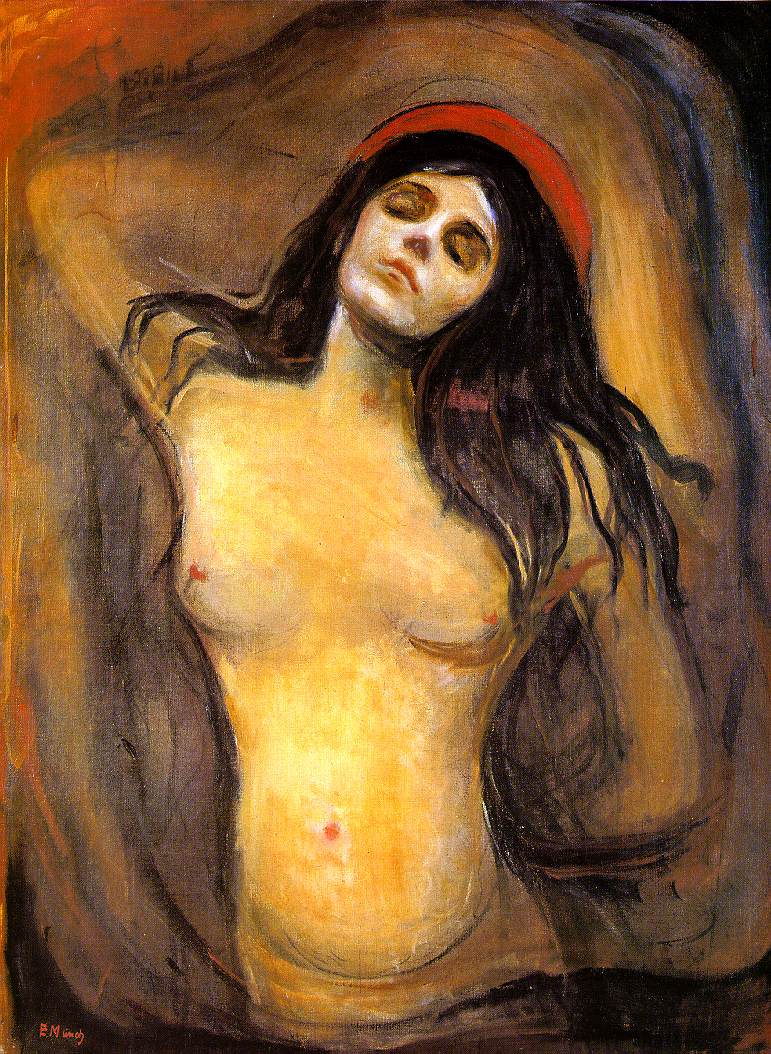
Ladies, would you let an artist paint your portrait if his art was notoriously misogynist? Whether or not Edvard Munch's art is misogynist is, of course, up for debate but I've always gotten the distinct impression that women in his artwork belong with death, destruction and teh eeeeeevil s-e-x. I mean, even his painting of the Virgin Mary is really... vampy. Like she's having a naughty Lord-gasm. So imagine my surprise when I came across this thoughtful, insightful and lucid portrait. Her body is portrayed skillfully as an expression of an attitude rather than a decoration; her face is a very appropriate balance between an invitation to admire and a window into her thoughts. I also admire the mix of her passive gaze "off-screen" and her solid, almost swaggering stance.

Edvard Munch, Birgitte Prestoe. c. 1924.

Wednesday, January 5, 2011

New Year's Resolutions!

1. To be able to complete at least one push-up by 2012. I gave this a good try last year and although I achieved two granny-style push-ups in a row at one point, I ultimately failed.

2. Leave the house more.

3. Be braver about asking people and scheduling people to do non-commercial portraits.

4. Eat more vegetables.

5. Make at least $1000 more than in 2010.

6. Have my work in at least TWO shows.

7. Don't look down at the ground when I'm out in public. I'm not in DC anymore; I don't have to avoid eye contact!

Monday, December 6, 2010

What's a little jab at the legitimacy of your worldview between friends?

I was put on the spot at a party in order to defend modern art's legitimacy AGAIN. Um, do people not know it's impolite to follow up the question, "what do you do," with the demand to prove that a) art--and by association my PROFESSION--is not a hoax, b) the subject of my degree is not something their child could do, c) that artwork is, in fact, worth its monetary value and not some grand scheme to line the pockets of that massive army of filthy rich artists we all know is taking over the world. "But why can't I understaaaaaaand it?" they always want to know. Somehow the reply, "Because you're not very smart," is not on the table. The question sets me up for failure: what am I going to do, explain every single meaning of every twentieth century art movement to some jerk at a party?

Art Criticism and Politics

I just wanted to share this awesome post by Amanda Marcotte at Pandagon. It's a simple look at how the "this isn't art because my kid could do it" people fit into the larger conservative/liberal social context. Bonus points for bringing art criticism into music criticism; there needs to be so much more crossover!

Tuesday, October 12, 2010

Ramon Novarro


A lovely portrait of silent film "Latin lover" Ramon Novarro by Angel Zarraga. I wish American culture today weren't embarrassed by the idea of male beauty.

(I cannot find who the photographer was for the second portrait. Sorry!)

Monday, October 11, 2010

When Bad People Make Good Art


My dad was watching a baseball game when one of the best players stepped up to bat. "You know, that guy can really play ball. It's really too bad he's such a shit-ass."

Unfortunately the art world has some shit-asses too. There are the Leni Riefenstahls of the world, who have been associated with abominable things and whose art, too, is associated with those things. Their stuff is easy to admire once in a while from a technical standpoint and then stay away from the rest of the time. How often do I really want to watch Nazi propaganda, no matter how artfully directed? And then there are people like Chris Brown who do abominable things but the content of their art is unrelated. But the Chris Browns and Mel Gibsons of the world don't bother me so much either because their art sucks and I would've disliked it anyway. But then there are the Wagners, the Larry Riverses, the Buster Keatonses whose stuff is a little harder to stay away from.

Sometimes I have to bend backward over historical attitudes to appreciate art. Wagner was a raging anti-semite and even in his time that wasn't completely acceptable. But it was a lot more accepted by his society, pre-Holocaust and chauvinistically Christian. Caravaggio actually committed murder, which wasn't historically acceptable but I guess it was such a long time ago no one really cares anymore. And I adore Buster Keaton's silent movies... but not the black-face scene in The College. I get the feeling that it was completely acceptable to white Americans in the twenties, and all in good fun but there is no way I feel ok watching that. And Hugh Laurie, whom I adore, appeared in black-face in the fantastic series Wooster & Jeeves, which is so recent that I was absolutely shocked by that scene.

And then there's Larry Rivers, a contemporary artist who died in 2002 who made a "documentary" film of his two daughters growing up through puberty, which is so insensitively made it is certainly tantamount to sexual abuse and possibly child pornography. His daughters, now adults, seem to have been hurt by his actions and do not approve the artwork or the public's possession of it. There's really no historical attitude he can hide behind, either. It colors the rest of his work for me; for some reason knowledge of sexual abuse, more than anything else, affects how I see a person's every action thereafter. I think people see Roman Polanski's movies the same way now. Drugging and raping a thirteen-year-old girl is pretty hard to forget. All his films are a little ickier now.

But I have the option of stretching to see beyond that. After all, if I can appreciate a Wagner piece or freak out in front of Rosemary's Baby I can only gain from that experience. Mahler, who was Jewish until converting for possibly political reasons, welcomed the chance to conduct Wagner pieces, remarking that Wagner had never composed an anti-semitic note. Ultimately if I reject great art because it's tainted, I lose out.

Not everyone sees it that way though. Denial seems to be a popular option. But even IF members of the general public acknowledge that the artist did a terrible thing, many people declassify the art as "art." I definitely consider Rivers' documentary to be art as well as evidence of sexual abuse but the popular opinion of commenters who did not defend his actions was that the film was simply not art and he was simply not an artist. People also seem to be piping up to say that Polanski's films are not all that great, or that a filmmaker isn't really an artist, or some variation on the theme of "Hollywood blows." The drummer from the Velvet Underground has recently joined the Tea Party movement, which is seen as politically reprehensible to the leftist fanbase. Suddenly comment sections are peppered with, "whatever, the Velvets weren't that great anyway. And she was just a drummer." This is easy to get away with because many people can't see weird contemporary art as art even when morality isn't an issue. We're still expecting museums to be filled with Monets. (This isn't applicable to problematic art that predates Modernism, perhaps, because the art historians have declared it to be Great and no one can really argue with that).

People are kind of hostile to art, ready to take it down a few notches at the slightest provocation. This may seem like a leap but I associate this attitude with mob attitudes toward minorities. When women fail to please or act "wrong" people claim she's not really a woman: she's got a penis hidden in her pants, she's a cold childless un-mother, she's just a whore, she's unfuckable. People do this to Black people sometimes too, sadly. "So & So doesn't act how I think Black people act, therefore they're White at heart [insert offensive food product slang here]." It happens, in fact, to most people at some point in their lives for some reason.

The common problem, it seems, is that people are trying to define the world without listening to other people's definitions of themselves and their worlds, without accepting that paradoxes and contradictions exist (usually even within one's own rigid definitions). Maybe it's easier to start expanding one's mind with morally ambiguous artwork, and then tackle something else a little tougher.

Portrait of a Lady (or, "Your Hair is Fine, Really")


So: I'm a portrait artist. I like strange, daring or intensely thoughtful portraits and do them when I can, but every Saturday I go to the Farmer's Market and sketch charcoal portraits of people that take about a half-hour each. It's fun. I love people's faces, it's good exercise, it pushes me out of the analytical-painter-rut I sometimes get stuck in. Plus I like tourists.

I draw lots of different kinds of people--and pets-- and I'm surprised by how much more I enjoy drawing them than I anticipated. The dogs are a great exercise in texture. Kids say beautifully contemplative stuff after sitting still for thirty minutes. Couples are so sweet to draw (usually) and the confident, curious adult who simply wants a portrait is always interesting.

I thought I already had strong views on feminine beauty and its place in the patriarchy (hell yeah I'm a feminist!) but again I have been surprised by what I've learned.

First, I have only drawn five women, ever, who did not say something apologetic, worried and peppered with nervous laughter about their hair as they sat down. Only one girl under 18-ish ever mentioned her hair, and she was an elementary-school-aged kid whom her mother had dressed as a beauty queen. Yeesh. Personally I try to emphasize messy hair because it breathes a bit of life into a portrait. It keeps people from looking... embalmed. And for the record: their hair always looks fine in real life. Always.

And then there are the modest ladies.

The husband/boyfriend will see the Portraits sign, light up and say "Honey! You should get a portrait! C'mon, you're gorgeous!" But Honey has to act embarrased, argue, be persuaded, and pretend to be reluctant. Usually I can tell she is secretly delighted but has to put on the act of modesty anyway. It's not like there's any socially acceptable way for a woman to say "You're right, I am gorgeous. Let's get this shit framed!"

In fact, the only way that many women can be persuaded to get a portrait is to include a mom or child, and make it a "me & mom moment." To simply have a portrait of oneself would be vain. I suppose they figure it's only a short leap from having a framed photo of yourself, to filling your bedroom with "boudoir photos," to starring in Sunset Boulevard. It's sad because many single and married men will stop by alone who are completely unencumbered with painful self-awareness, declare the awesomeness of portraiture, and sit happily for a portrait simply because they're curious.

I guess the Man Version of 'Aww shucks,' is, "Ha! You don't wanna draw me, sweetheart! I'm so ugly your pencil would break!" Followed by hearty laughter. But no shame. I have to bite my tongue to keep from saying, "But ugly people make the best portraits!"

So this got me thinking about female beauty in a new way. I'm going to do a few posts here exploring that. I promise, though, no nonsense about women's beauty being God's gift to man or carelessly conflating "sexy" with "beautiful." Ugh.

Sunday, March 21, 2010

Unusual Portait Poses

My favorite part of portraiture-- I think-- is finding a fantastic pose or composition that makes the final portrait insightful and un-cheesy. I need to remember, when doing quick portrait sketches, to take a little time before I start to consider pose and composition. These are some really interesting ways of portraying someone besides the "sit for a mugshot."


Marcel Duchamp. Nude Descending A Staircase. [This may not be a portrait but I used it for the idea of a portrait in motion. Duchamp actually painted the very similar Sad Young Man in a Train, which he identified as a self-portrait.]


Marcel Duchamp. Self Portrait.


Edgar Degas. Portrait of Duranty.


Degas. Portrait of Diego Martelli


Charles Curran


Norman Rockwell, The Problem We All Live With.


Joyce Cambron
"Dickenson Shirt"

Friday, March 19, 2010

Mark Kang-O'Higgins


Please, please click on the portrait to see a the larger version at Mark Kang-O'Higgins' website! All of his work-- landscape paintings, figure drawings, portraits-- have this liquid quality.

Portrait of Andy Warhol

That distinctive expression of an electrocuted corpse may give Warhol his instantly recognizable look but this classical treatment of such an anti-classical icon is so thoughtful and frank that it makes me re-think classical portraiture, this particular artist's work (which I already admired), Andy himself, and my own conditioned assumptions about him.

The painting is by Andrew Wyeth's son (and N.C. Wyeth's grandson, Carolyn Wyeth's nephew) James Wyeth.

I hadn't really looked at this portrait until I read Eric Stengel's essay about Andy Warhol being a founding member of the classical art atelier New York Academy of Art. It was there Stengel encountered the work of Camie Davis, whose work was featured in an exhibit in Stengel's hometown.

If you haven't seen Camie Davis' work, check out her website. Even if you're not into classical figurative work (or the "derriere guarde")her technique will probably still make you drool. And if you like her work, you might also enjoy Farrar Hood, Jason Talley, Joyce Cambron and Mark Kang-O'Higgins.

Wednesday, February 25, 2009

Says Andrew Stiller...

So I sort of wanted to read Why Are Artists Poor already, and then I came across this review. Scroll down the page and check out the review by Andrew Stiller. I, too, have often wondered how philistinism and the economics of the Arts have been intertwined.